The official X API no longer has monthly plans. You buy credits, and each request takes money off that balance. Reading one post costs half a cent. Reading a user profile costs one cent. Below are the published rates, what common workloads cost at those rates, and the cases where the official API is the one you should use.
All prices were checked on 2026-10-09 against the X API pricing page. X says prices are subject to change and that the Developer Console always shows the current rates, so look there before you set a budget.
The $200 and $5,000 plans are gone
For years the X API was sold as a subscription. The entry paid plan was $200 per month and the next tier was $5,000 per month.
GIGAZINE reported that @XDevelopers announced general availability of pay-per-use on February 6, 2026. It had been in a closed beta since around October 2025. Users on the legacy Free plan got a one-time $10 voucher.
Open Terms Archive recorded the same change: the flat-rate $200 and $5,000 plans were replaced by pay-per-use. It also notes that commercial uses still require an Enterprise plan. If you are building a product you sell, read the current terms before you assume pay-per-use covers you.
You buy credits first, then pay per request
The pricing page describes the model in a few lines. There is no subscription. You buy credits upfront in the Developer Console, and every request deducts its published rate from your balance.
To get that far you need an X developer setup. The X API overview says to sign up at console.x.com, create an app and get credentials from it.
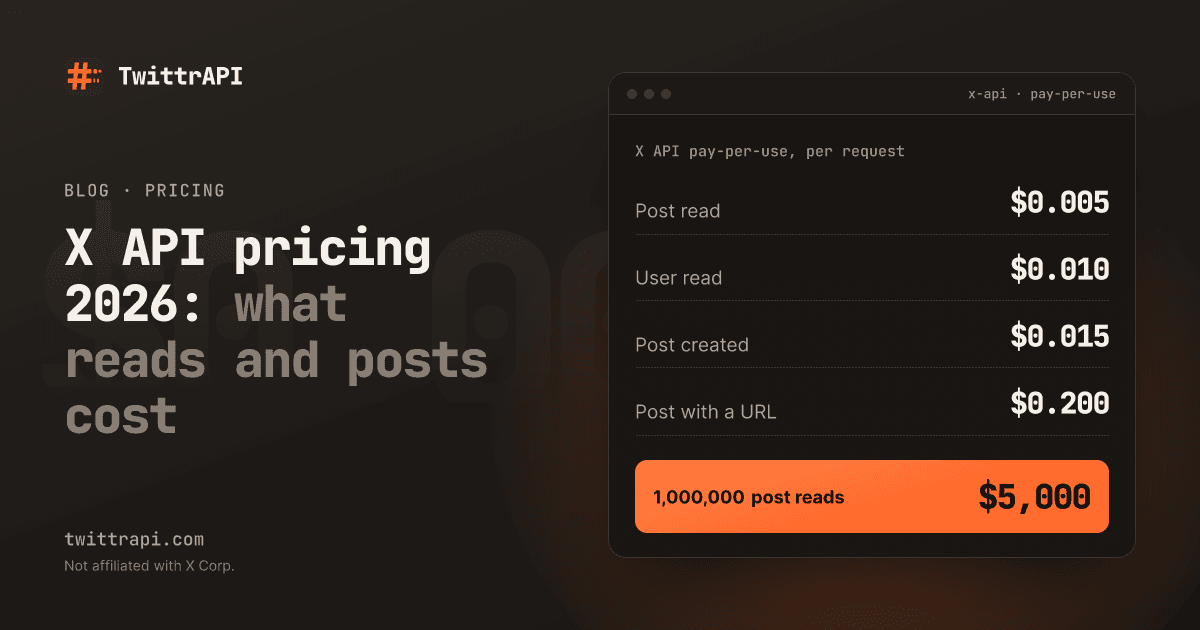
Reads cost $0.005 per post and $0.010 per user
These are the main rates on the pricing page today:
| Operation | Price | Unit |
|---|---|---|
| Posts: Read | $0.005 | per resource (post) |
| User: Read | $0.010 | per resource (user) |
| Owned reads | $0.001 | per resource |
| Post: Create | $0.015 | per request |
| Post: Create (with URL) | $0.200 | per request |
Look at the unit column. Reads are charged per resource, so per post or per user object you get back. One HTTP request that returns 100 posts is billed as 100 post reads, which is $0.50. Writes are charged per request.
Owned reads, meaning data about your own account, are cheap at $0.001. Reading other people's public posts and profiles is where the money goes.
Pay-per-usage stops at 3 million post reads a month
Pay-per-usage is limited to 3 million post reads per monthly billing cycle. Past that, X sends you to Enterprise. At $0.005 per post, reaching the cap costs $15,000, so most small projects will never see it. A monitoring or research pipeline that reads large volumes of posts can hit it.
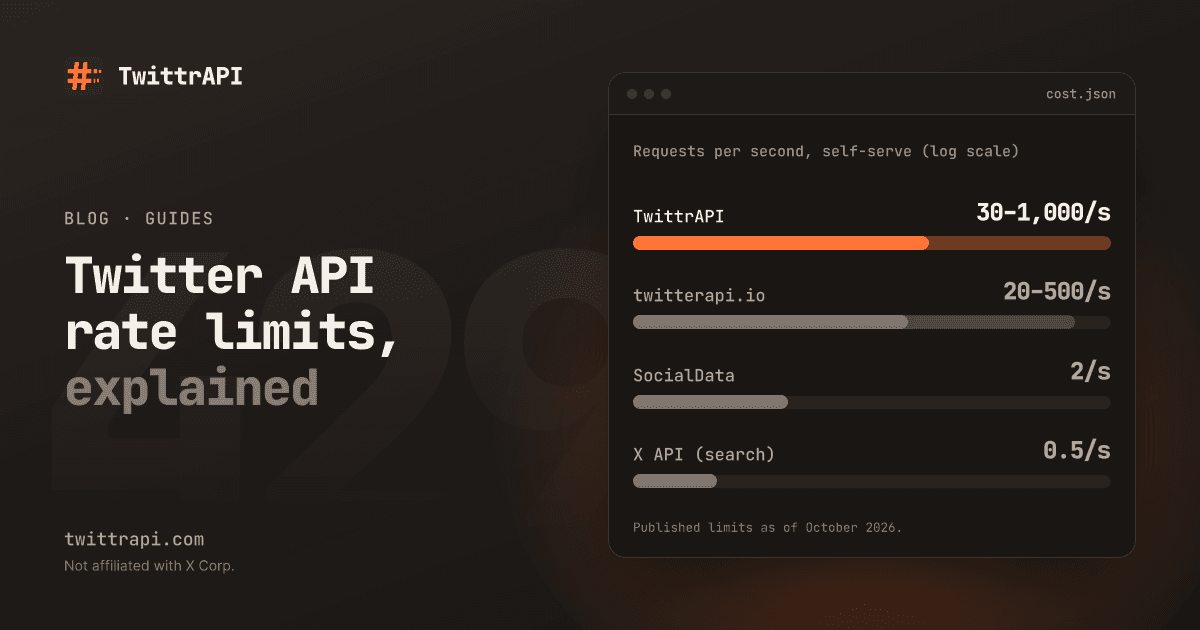
The cap is separate from rate limits, which restrict how many requests you can send per 15-minute window on each endpoint. Twitter API rate limits explained covers those.
Current promotions
The pricing page lists three promotions right now:
- $20 in free credits after you save your first eligible card.
- Your first auto-recharge is matched, up to $50.
- Up to 20% back in xAI API credits.
Promotions change more often than base rates. Treat this list as a snapshot from the date above.
What typical workloads cost
The examples below use only the base rates and leave promotions out.
1,000 posts cost $5
| Posts read per month | Cost at $0.005 per post |
|---|---|
| 1,000 | $5 |
| 10,000 | $50 |
| 100,000 | $500 |
| 1,000,000 | $5,000 |
| 3,000,000 (the cap) | $15,000 |
One million post reads cost $5,000, the same as the old $5,000 monthly plan.
10,000 profiles cost $100
At $0.010 per user, 10,000 profile lookups cost $100 and 100,000 cost $1,000. A user read is twice the price of a post read. If your product enriches account lists (a CRM pulling follower counts and bios, say), profiles can end up as your largest cost.
A post with a link costs $0.20 instead of $0.015
A plain post costs $0.015, so 1,000 posts cost $15. A post containing a URL costs $0.200, so 1,000 of those cost $200. For a scheduler or a bot that shares links, budget with the URL rate. The plain rate will make your estimate far too low.
A small analytics tool: $360 a month
Say a tool reads 50,000 posts, looks up 5,000 profiles and publishes 300 posts with links each month:
- 50,000 posts x $0.005 = $250
- 5,000 users x $0.010 = $50
- 300 posts with URL x $0.200 = $60
A small analytics tool on the official X API, per month
- 50,000 posts read x $0.005 = $250
- 5,000 profiles read x $0.01 = $50
- 300 posts with a URL x $0.20 = $60
That is $360 per month before promotional credit. Reads make up $300 of it.
Use the official API for posting
We run a third-party read API, and we still send people to the official API in these cases:
- Posting and acting for users. Creating posts, replying or doing anything on behalf of a user needs the official API and the user's authorization. The official API is the right tool for posting.
- Your own account's data. Owned reads at $0.001 are inexpensive, and you are reading your own data through X's own channel.
- A contract with X. If your company needs a direct agreement with X, a documented data licence or a compliance trail, go official.
- Change notices. X announces changes to its own API. Third-party providers have no such relationship with the platform.
- Very high volume or commercial terms. Above 3 million post reads per month, or where the terms require it, you need Enterprise.
Third-party APIs are cheaper for public reads
If most of your bill is reading public data (search, user timelines, follower lists, profile lookups), third-party APIs cost a fraction of the official rates. They are not affiliated with X and only return public data. They also price in different units: some charge per item returned, some per call. That makes direct comparisons harder than the headline numbers suggest.
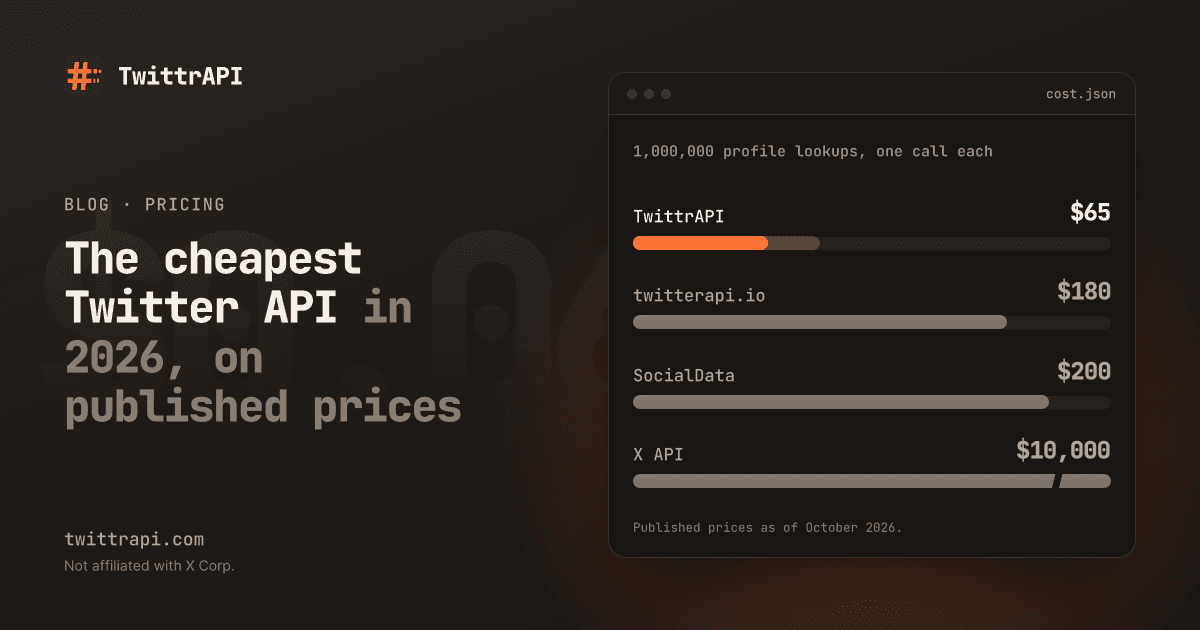
TwittrAPI is one of them. We charge per API call, from $0.065 per 1,000 calls on the Scale tier, $0.075 on Volume and $0.09 on Standard. Compare that with the official API: a single profile lookup is one call, so 1,000 lookups cost between $0.065 and $0.09 with us and $10 at X's user read rate. For search and timelines the comparison depends on how many results each call returns, which varies by endpoint and query. Run your own queries before trusting any per-tweet figure.
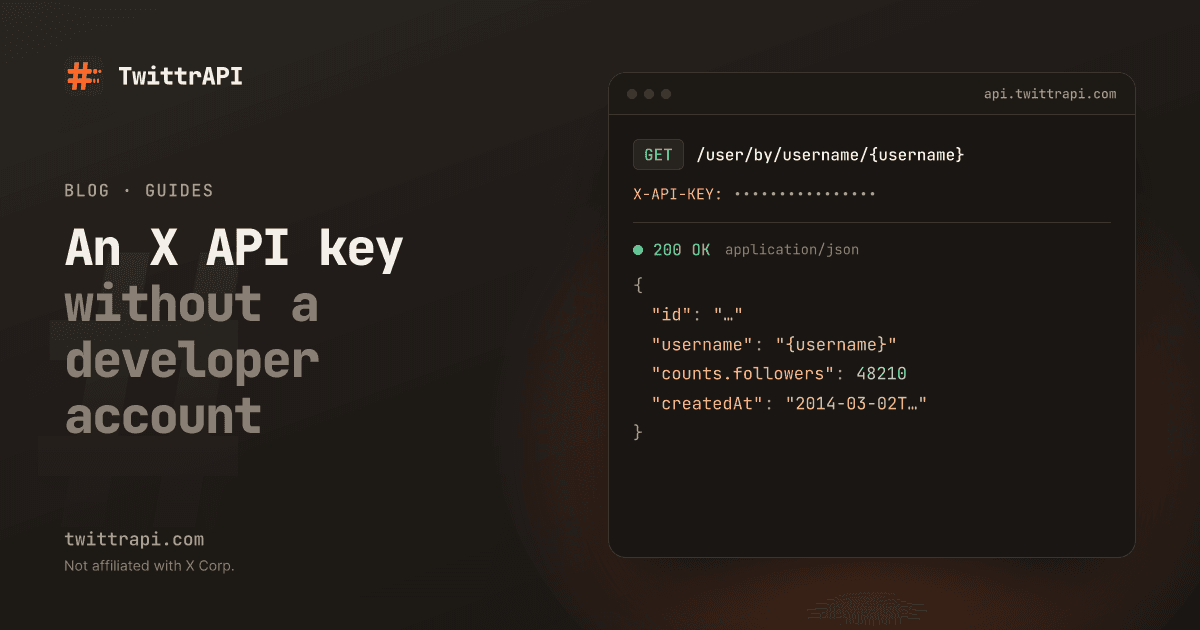
We put the providers side by side in the cheapest Twitter API in 2026. TwittrAPI vs the official X API compares limits, onboarding and endpoints, and the migration guide from the X API maps v2 read endpoints to ours. If you want to know what "no developer account" means in practice, read how to get an X API key without a developer account. Our current rates are on the pricing page, the documentation shows how requests work, and you can get a key with $0.10 of test credit from /start.
Frequently asked questions
How much does the X API cost per month?
There is no fixed monthly price any more. You buy credits in the Developer Console and each request deducts its rate: $0.005 per post read, $0.010 per user read, $0.015 per post created and $0.200 per post that contains a URL. What you pay in a month depends on how much you read and write.
Is there still a free X API tier?
Not as a monthly allowance. Pay-per-usage runs on prepaid credits. The pricing page currently lists $20 in free credits after you save your first eligible card, and users of the legacy Free plan got a one-time $10 voucher when pay-per-use launched.
What happens after 3 million post reads in a month?
Pay-per-usage stops at 3 million post reads per monthly billing cycle. Above that X directs you to an Enterprise plan.
Do I need an X developer account to use the X API?
Yes. Official keys come from console.x.com, where you create an app and get credentials. Third-party APIs for public data issue their own keys; how to get an X API key without a developer account explains the difference.