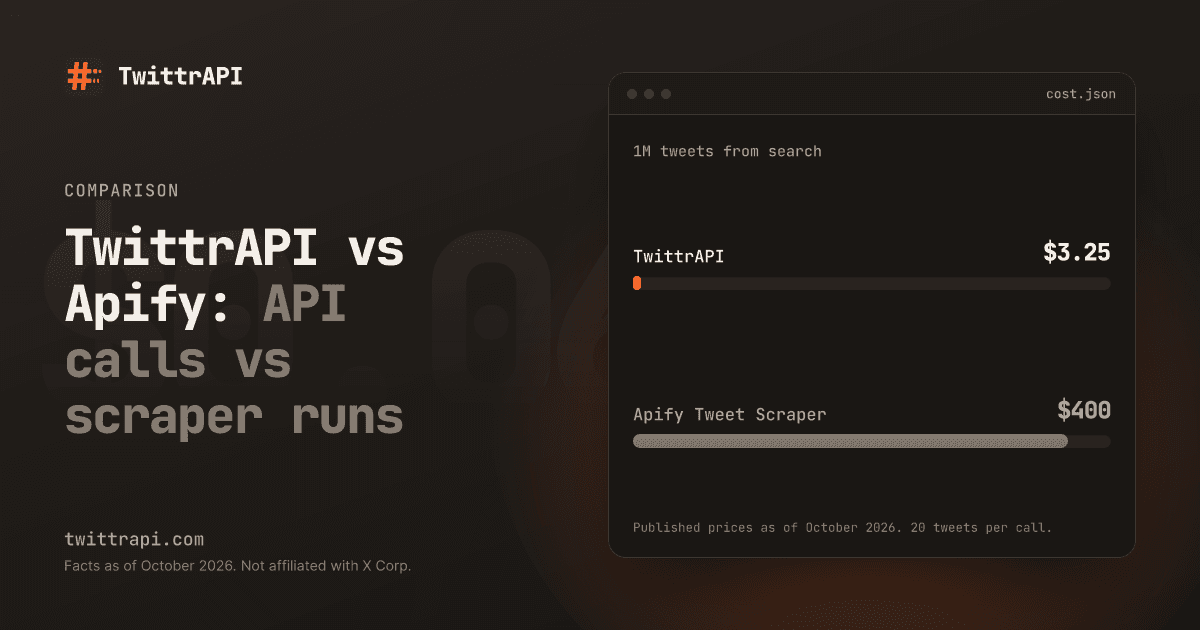
Apify is a platform for running scrapers, called actors. Several independent developers publish Twitter/X actors there, and you pay per result plus your Apify plan. TwittrAPI is a REST API: you send a request and get the data back in the response, priced per call.
We run TwittrAPI. Apify details below come from apify.com and its Store API, checked on 10 October 2026; each number links to its source. Actors are run by their authors, not by Apify, and each sets its own price and rules.
Popular Twitter actors (as of October 2026)
The four most popular Twitter actors in Apify's own popularity sort when we checked.
Tweet Scraper V2 (apidojo)
Price$0.40 per 1,000 tweetsas of Oct 2026
Notable limitsat least 50 tweets per queryas of Oct 2026; 1 concurrent run with up to 5 queriesas of Oct 2026; no single tweets or conversations; free-plan users get 5 runs of 10 items a month, no API accessas of Oct 2026
Twitter Scraper Unlimited (apidojo)
Price$0.40 to $2.00 per 1,000 items, plus per-query feesas of Oct 2026
Notable limitsTiered by volume
Tweet Scraper, pay per result (kaitoeasyapi)
Price$0.18 to $0.25 per 1,000 tweets, depending on your Apify planas of Oct 2026
Notable limitsSee the actor page
Twitter User Scraper (apidojo)
Price$0.40 per 1,000 users, plus per-query feesas of Oct 2026
Notable limitsminimum 5 items per runas of Oct 2026
Results are paid from Apify platform usage. The Free plan includes $5 of usage per monthas of Oct 2026; paid plans are Starter $19, Scale $199, Business $999 per month (monthly billing)as of Oct 2026.
TwittrAPI vs Tweet Scraper V2
X-API-KEY headerApify API tokentext, likeCount, author)For a page of 20 tweets, which is our default count (X decides the real number), 1,000 tweets take 50 calls: $0.00325 to $0.0045 on TwittrAPI against $0.40 per 1,000 tweetsas of Oct 2026 on this actor. That assumes full pages, so measure with your own queries.
Where Apify is the better fit
- No code. Start a run in the browser, download CSV or JSON, or send it to Google Sheets.
- Scheduling and integrations are part of the platform.
- Clean output. Items are flat objects, ready for a spreadsheet.
- One platform for many sites, if you scrape more than X.
Where TwittrAPI fits better
- Request-response use: bots, dashboards and backends that need one answer per request.
- Small lookups, such as one tweet or one profile, which some actors do not offer or price per query.
- Cost at volume, because a page of results is one call.
- More endpoint types in one place: replies, followers, lists, communities, trends, job listings.
If you like Apify as a platform, you can also call TwittrAPI from your own code and keep your scheduling elsewhere. Try it with the $0.10 test credit from /start. Our endpoint reference is in the docs.
TwittrAPI is not affiliated with X Corp. or Apify. Reading data needs no X account; optional account actions use your own X session cookie and proxy.
Frequently asked questions
How much do Apify Twitter scrapers cost?
The most popular actor, apidojo's Tweet Scraper V2, lists $0.40 per 1,000 tweetsas of Oct 2026. Other popular actors list $0.18 to $0.25 per 1,000 tweets, depending on your Apify planas of Oct 2026 (kaitoeasyapi) or $0.40 to $2.00 per 1,000 items, plus per-query feesas of Oct 2026 (apidojo's Twitter Scraper Unlimited). This is paid from your Apify usage; the Free plan includes $5 of usage per monthas of Oct 2026.
Can I fetch a single tweet with Apify?
Not with Tweet Scraper V2: its page says single-tweet fetching and conversation scraping are not offered and that each query must return at least 50 tweets per queryas of Oct 2026. Other actors handle single tweets at their own prices.
Is an API or a scraper better for real-time use?
An API call returns in one request. An Apify actor runs as a job that you start and then read the dataset from. For dashboards and bots that need an answer per request, an API is simpler; for scheduled bulk exports, an actor works well.
Can I use TwittrAPI from Apify or no-code tools?
TwittrAPI is a plain REST API with an X-API-KEY header, so any tool that can make HTTP requests can call it. Step-by-step recipes for n8n and Make are on Twitter/X data in n8n and Make.